AI Lead Scraper — Without the Invented Emails
People searching for an AI lead scraper almost always want the same thing: describe the leads you want, get a clean list back, write no code. That's a completely reasonable thing to want, and it's exactly what 1Scrape does. But it's worth being precise about where the intelligence in a lead tool should live — and where it absolutely shouldn't.
1Scrape does not use a language model to produce your contacts, and that's a feature, not a gap. Contact data is the one place where a system that generates plausible-looking output is actively dangerous. Every email and phone number in your CSV was read from a public profile or a business's own website. None of it was inferred, pattern-guessed, or written by a model.
$5.00 free to start · no card required · failed runs are free
What lands in your CSV
One row per result, every field in its own column — no cleanup, no copy-paste. Here's the shape of the file you download:
| name | phone | website | rating | reviews | |
|---|---|---|---|---|---|
| Ridgeline Roofing | (214) 555-0132 | office@ridgelineroof.com | ridgelineroof.com | 4.8 | 126 |
| Cortez & Sons Roofing | (214) 555-0177 | — | no website | 4.6 | 83 |
| Summit Roof Co. | (972) 555-0119 | hello@summitroof.co | summitroof.co | 4.9 | 241 |
What it looks like
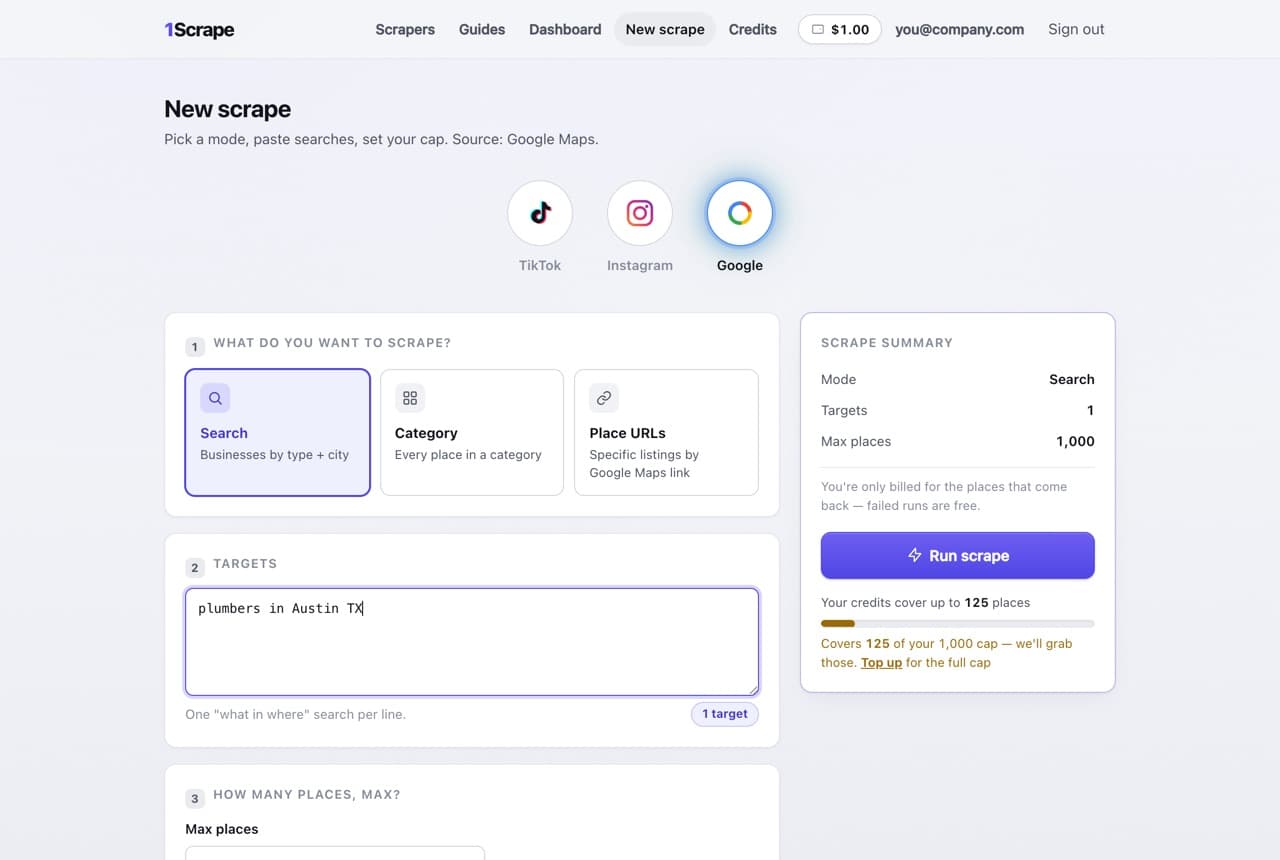
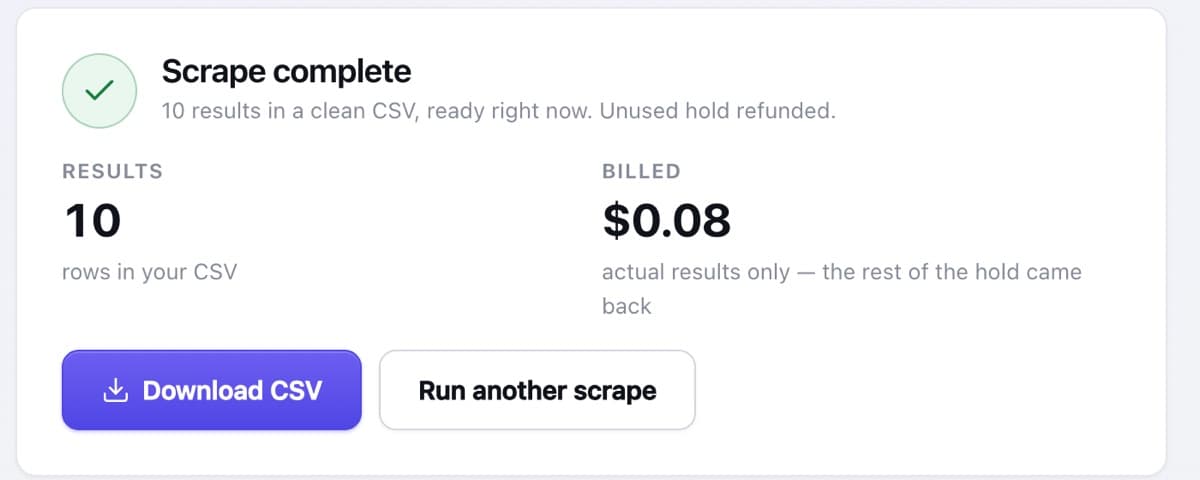
Why "AI-generated" and "lead list" don't mix
A language model's job is to produce the most plausible next token. Ask one for the email address of a roofing company in Dallas and it will happily give you something that looks exactly right — the correct format, a believable name, the real domain. It may also be entirely fictional, and it will not tell you which.
That failure is quiet and expensive. Invented addresses bounce, and a bounce rate above a few percent gets your sending domain throttled or blacklisted — which poisons the outreach you were doing correctly. A guessed phone number is worse: it belongs to a real person who did not ask to hear from you. The tool that hands you a beautifully full email column is often the one that made most of it up.
What you actually want from an "AI" lead scraper
Strip the word away and the requirements are concrete. Every one of these is something 1Scrape does today:
Describe it in plain language
"Plumbers in Austin." "Creators posting under #cleantok." You fill in a form, not a config file — no selectors, no XPath, no API keys.
No code, ever
Nothing to install, no script to maintain, no Chrome extension to break the next time a platform ships a redesign.
It runs itself
The collection happens on our servers, page after page, while you close the tab. You watch a live counter and download a CSV.
Real data only
Every row traces back to something publicly published. Gaps in the email column are honest gaps — profiles that never listed one — not filled in with a good guess.
Where a model genuinely helps — and where we'd tell you so
There are legitimate uses for AI downstream of a lead list. Classifying which of your scraped businesses are franchises. Drafting a first-pass outreach email. Scoring which creators fit a brand. Those all operate on data you already have, so a wrong answer is a bad suggestion rather than a fabricated fact.
Collecting the data is the opposite case. It has exactly one correct answer, and it's already written on the page. If we ever add a model to this product, it will be for the sorting and the drafting — and we'll say so plainly, on this page.
What comes back
Local businesses
From Google Maps: name, full address, phone, website, category, rating, review count, and a flag on the ones with no website at all.
Creators
From TikTok and Instagram: username, follower count, engagement, bio, and the public email, phone, and link they chose to publish.
One row each, one clean CSV
Opens in Excel, Google Sheets, or Numbers, and imports straight into a CRM or an outreach tool.
How it works
Say what you want
Pick a source and describe the leads in plain words — a search, a hashtag, a city, a list of profiles.
Filter to contactable
Keep only rows with an email or a phone, so the file that lands is a working list rather than a research project.
Watch it run
The count climbs live. Starting a run only ever holds its worst-case cost, and the unused portion is refunded the moment it finishes.
Download real contacts
Billed per result actually scraped. Failed runs are free. Nothing in the file was invented.
Frequently asked questions
Is 1Scrape an AI scraper?
Not in the sense of using a language model to produce your data, no — and we'd rather say so than let you find out from a bounce report. It does the job people usually want an "AI scraper" for: you describe the leads in plain language, it collects them automatically with no code, and it hands back a clean CSV. What it will not do is generate a contact that it didn't read from a public page.
Why does AI-generated contact data bounce?
Because a language model produces what is plausible, not what is true. Email addresses have an extremely predictable shape, which makes them very easy to fabricate convincingly and impossible to distinguish from real ones by eye. The addresses bounce, your sender reputation drops, and the deliverability of your legitimate outreach goes with it.
Can I use AI on the results?
Absolutely, and that's the right place for it. Once you have a CSV of real contacts, feeding it to a model to segment the list, score fit, or draft a first-pass message is genuinely useful — because the model is working from facts you already collected rather than inventing them.
Do I need to know how to code?
No. You fill in a short form — what to scrape and how many results you want — watch the count climb live, and download the CSV when it finishes. There's nothing to install and no API to wire up.
How much does it cost?
Runs are priced at $8 per 1,000 results, and every new account starts with $5.00 in free credits — enough to pull thousands of rows before you pay anything. You're billed per result scraped — never for your full cap — and the unused hold is refunded the moment a run finishes. If you use a lead filter like "only profiles with an email", the CSV keeps just the matches while you still pay per profile scraped. If a run fails, it's refunded in full and never costs a credit.
Is this legal?
We only collect data that's already public — the same posts, captions, counts, and the contact info creators choose to put in their public bio. We don't touch private accounts or log-in-gated content, and we never try to reach anything a creator has kept private. You're responsible for using the data in line with TikTok's terms and any privacy laws that apply to you, so scrape public data, respect people's rights, and don't spam.